
How to Prepare for Research Assistant Interviews: Research Assistant positions are among the most competitive academic and research opportunities available to graduates and postgraduates. Universities, research institutes, business schools, public policy organizations, and government-funded projects regularly recruit Research Assistants to support data collection, analysis, literature reviews, and project management.
A strong academic record can help secure an interview, but selection committees often place equal importance on analytical thinking, communication skills, research aptitude, and technical competence.
Candidates who prepare systematically are far more likely to succeed.
Understanding the role of a Research Assistant
Before preparing for an interview, it is important to understand what a Research Assistant actually does.
The responsibilities vary across institutions and projects, but common duties include:
- Conducting literature reviews
- Collecting and organizing research data
- Managing surveys and questionnaires
- Preparing reports and presentations
- Supporting faculty members and principal investigators
- Performing statistical analysis
- Assisting with academic publications
Interviewers often assess whether a candidate understands these responsibilities and can contribute effectively from the beginning.
Study the job description carefully
Many applicants focus exclusively on interview questions while ignoring the job advertisement.
This is a mistake.
The job description often reveals the skills, software, and subject knowledge expected from candidates.
Pay attention to:
| Area | What to Review |
|---|---|
| Subject Knowledge | Core concepts related to the research project |
| Technical Skills | Excel, SPSS, Stata, R, Python, SQL, NVivo |
| Research Methods | Quantitative and qualitative techniques |
| Communication Skills | Report writing and presentation abilities |
| Project Requirements | Data collection, surveys, fieldwork, analysis |
A clear understanding of the advertised role allows candidates to tailor their preparation accordingly.
Strengthen your research methodology fundamentals
Research methodology forms the foundation of most Research Assistant interviews.
Candidates should be comfortable discussing:
- Research design
- Sampling techniques
- Survey methods
- Questionnaire development
- Data collection procedures
- Qualitative research methods
- Quantitative research methods
- Reliability and validity
- Research ethics
Interviewers frequently ask candidates to explain these concepts in simple language.
The ability to communicate complex ideas clearly is often viewed as a strong indicator of research potential.
Review statistical and analytical concepts
Many Research Assistant positions require basic data analysis skills.
Candidates should revise topics such as:
- Mean, median, and mode
- Correlation
- Regression analysis
- Hypothesis testing
- Standard deviation
- Sampling error
- Descriptive statistics
Even when advanced statistical expertise is not required, interviewers often expect candidates to understand fundamental analytical concepts.
Read Also: IIM Lucknow Research Assistant Recruitment 2026: Apply Online for ₹40,000 Fellowship
Become familiar with research software
Academic and policy research projects increasingly rely on software tools for data analysis and management.
Commonly requested tools include:
| Software | Typical Use |
|---|---|
| Microsoft Excel | Data organization and analysis |
| SPSS | Statistical analysis |
| Stata | Econometric research |
| R | Statistical computing |
| Python | Data analysis and automation |
| SQL | Database management |
| NVivo | Qualitative data analysis |
Candidates do not need expert-level proficiency in every tool.
However, they should be prepared to discuss any software listed on their resume.
Read recent research papers-How to Prepare for Research Assistant Interviews
One of the most effective preparation strategies is reviewing recent publications related to the research area.
Focus on:
- Research objectives
- Methodology
- Findings
- Limitations
- Policy implications
Candidates applying to academic institutions should also review publications authored by the faculty member or research team conducting the recruitment.
This demonstrates genuine interest and preparation.
Prepare for commonly asked interview questions
Research Assistant interviews often include questions such as:
Why do you want to work as a Research Assistant?
Interviewers look for evidence of intellectual curiosity, academic interest, and commitment to research.
Describe a research project you have completed.
Candidates should explain:
- The objective
- Their specific role
- Methodology used
- Key findings
- Lessons learned
How would you conduct a literature review?
A structured answer should include:
- Identifying relevant sources
- Reviewing academic databases
- Evaluating study quality
- Organizing findings by theme
- Identifying research gaps
How would you handle incomplete or inaccurate data?
Interviewers want to assess problem-solving ability, attention to detail, and understanding of data quality standards.
Demonstrate strong communication skills
Research work involves extensive communication.
Research Assistants often prepare reports, summarize findings, communicate with participants, and present results to supervisors.
Candidates should practice explaining research concepts clearly and professionally.
Clear communication frequently distinguishes successful candidates from equally qualified competitors.
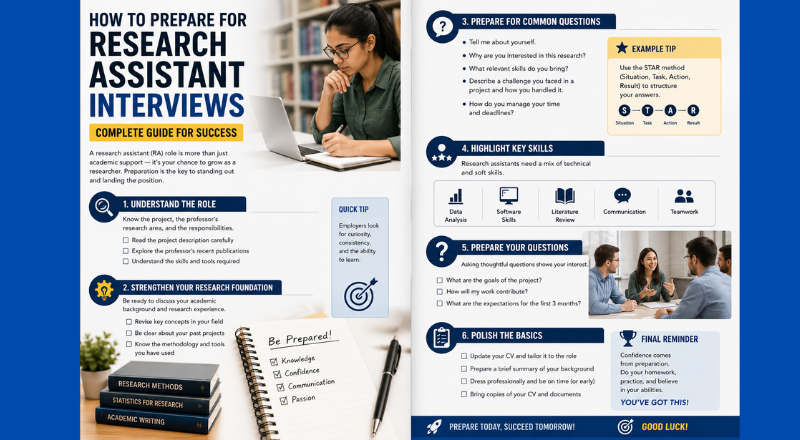
Prepare thoughtful questions for the interview panel
Employers appreciate candidates who take an active interest in the project.
Consider asking:
- What are the primary objectives of the project?
- What skills are most important for success in this role?
- Will the position involve publication opportunities?
- What training or mentorship opportunities are available?
Professional questions demonstrate preparation and enthusiasm.
Interview day preparation
Candidates should:
- Arrive early
- Carry all required documents
- Dress professionally
- Maintain a positive attitude
- Listen carefully before answering
- Support responses with examples whenever possible
Confidence should be balanced with honesty.
If you do not know an answer, acknowledge it respectfully and explain how you would approach learning the topic.
Research Assistant Interview Questions and Answers
| No. | Interview Question | Sample Answer |
|---|---|---|
| 1 | What is the role of a Research Assistant? | A Research Assistant supports research activities such as literature reviews, data collection, analysis, report writing, and project coordination. |
| 2 | Why do you want to become a Research Assistant? | I enjoy research, problem-solving, and academic work. This position will help me apply my knowledge while gaining practical research experience. |
| 3 | What is research methodology? | Research methodology refers to the systematic process used to conduct research, including data collection, analysis, and interpretation. |
| 4 | What is a literature review? | A literature review is a detailed examination of existing studies related to a research topic to identify findings and research gaps. |
| 5 | What is the difference between qualitative and quantitative research? | Qualitative research focuses on opinions and experiences, while quantitative research uses numerical data and statistical analysis. |
| 6 | What is primary data? | Primary data is collected directly from original sources through surveys, interviews, experiments, or observations. |
| 7 | What is secondary data? | Secondary data comes from published sources such as journals, books, reports, and databases. |
| 8 | What is sampling? | Sampling is the process of selecting a representative group from a larger population for research purposes. |
| 9 | What are common sampling methods? | Random sampling, stratified sampling, systematic sampling, convenience sampling, and purposive sampling. |
| 10 | Why is research ethics important? | Research ethics protects participants, ensures data integrity, and maintains public trust in research findings. |
| 11 | What is informed consent? | Informed consent means participants voluntarily agree to participate after understanding the study’s purpose and procedures. |
| 12 | What software have you used for data analysis? | I have experience using Excel and basic statistical tools. I am also familiar with SPSS, R, or Python for research analysis. |
| 13 | What is data cleaning? | Data cleaning involves identifying and correcting errors, duplicates, or missing values in a dataset. |
| 14 | How would you handle missing data? | I would identify the reason for missing values and apply appropriate techniques such as imputation or exclusion. |
| 15 | What is correlation? | Correlation measures the strength and direction of the relationship between two variables. |
| 16 | What is regression analysis? | Regression analysis is a statistical method used to examine relationships between dependent and independent variables. |
| 17 | What is hypothesis testing? | Hypothesis testing is used to determine whether research findings support a particular assumption or claim. |
| 18 | How do you organize research data? | I maintain structured files, proper documentation, backups, and consistent naming conventions. |
| 19 | How would you conduct a survey? | I would define objectives, prepare questionnaires, collect responses, analyze data, and present findings. |
| 20 | What would you do if you found errors in a dataset? | I would verify the source, correct errors where possible, and document all changes made. |
| 21 | Describe a research project you completed. | I would explain the objective, methodology, my responsibilities, challenges faced, and final outcomes. |
| 22 | What are your strengths as a Research Assistant? | Analytical thinking, attention to detail, communication skills, and the ability to learn new tools quickly. |
| 23 | Why should we hire you? | I possess strong research skills, academic knowledge, and a commitment to delivering accurate work. |
| 24 | How do you manage multiple deadlines? | I prioritize tasks based on urgency and importance while maintaining quality standards. |
| 25 | Where do you see yourself in 5 years? | I aim to develop advanced research expertise and contribute to impactful academic or industry projects. |
Quick Interview Preparation Checklist
| Preparation Area | What to Study |
|---|---|
| Research Methods | Qualitative and Quantitative Research |
| Statistics | Mean, Median, Correlation, Regression |
| Data Analysis | Excel, SPSS, Stata, R, Python |
| Academic Skills | Literature Review, Research Writing |
| Ethics | Confidentiality, Consent, Data Protection |
| Communication | Presentation and Report Writing |
| Subject Knowledge | Core Concepts from Your Degree |
| Current Affairs | Recent Developments in Your Field |
Skills Interviewers Usually Evaluate
| Skill | Why It Matters |
|---|---|
| Analytical Thinking | Helps interpret research findings |
| Attention to Detail | Ensures data accuracy |
| Communication Skills | Required for reports and presentations |
| Technical Skills | Supports data analysis tasks |
| Time Management | Helps meet project deadlines |
| Problem Solving | Useful when dealing with research challenges |
| Teamwork | Research projects often involve collaboration |
| Academic Writing | Required for publications and reports |
Final thoughts
Research Assistant interviews are designed to evaluate far more than academic qualifications. Employers seek candidates who can think critically, communicate effectively, manage research tasks responsibly, and contribute to the success of ongoing projects.
Careful preparation, a strong understanding of research methods, familiarity with analytical tools, and knowledge of the project’s objectives can significantly improve interview performance.
Candidates who invest time in understanding both the research process and the specific role are often the strongest contenders for Research Assistant positions.
[…] Read Also: How to Prepare for Research Assistant Interviews: Complete Guide for Success […]
[…] Read Also: How to Prepare for Research Assistant Interviews: Complete Guide for Success […]